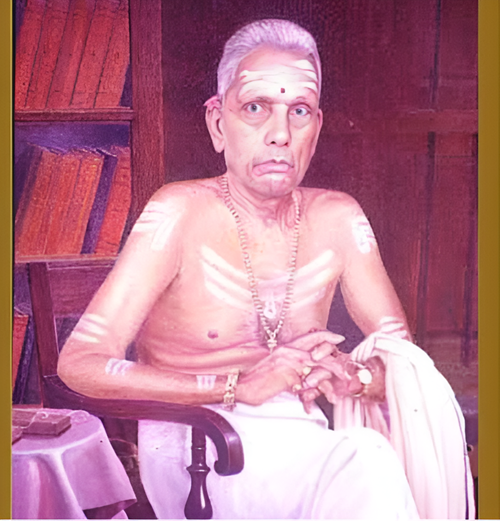
Panditha Raja Kavi Rathnam Attur Krishna Pisharody (1875–1964)
A Stalwart of Sanskrit, Nyāya, and Musicology
Panditha Raja Kavi Rathnam Attur Krishna Pisharody was one of the most illustrious Sanskrit scholars of Kerala, known for his erudition in Nyāya, Vyākaraṇa, Alaṅkāra, and Sangītaśāstra. His contributions to Sanskrit literature and music theory have left a lasting legacy.
Early Life and Education
Born on 29 September 1875 in Attoor Pisharam, a small village in Thrissur district, Kerala, he was the son of Vadakkedathu Narayanan Nambudiri and Pappikutti Pisharasyar. His initial education in Sanskrit came from his father. A maternal uncle, Bharata Pisharody, initiated him into classical Sanskrit, while further studies in Vyākaraṇa and Kāvyas were pursued under Meledathu Ramunni Nambiar.
A pivotal figure in his education was his paternal uncle, Vengeri Vasudevan Nambudiri, under whom he delved deeply into Nyāya, Vyākaraṇa, and Alaṅkāra. During his teenage years, he assisted in managing a Vedic school at Ceruvannur Sabhamatham, but dissatisfied with administrative duties, he left at the age of 18 with Rs. 25 in hand and set off for Kodungallur Kovilakam.
At Kodungallur, he studied Nyāya under Mahāmahopādhyāya Bhattashri Godavarma Tampuran, and this phase proved transformative in refining his intellectual and spiritual pursuits.
Return as a Scholar and Personal Life
At 22, he returned home as a fully accomplished scholar and began teaching Sanskrit. His first student was Mooppil Nair, a landlord and veena player, with whom he exchanged Sanskrit lessons for music training.
At 25, he married Nannikutti Pisharasyar of Vadakootu Pisharam, Pazhayannūr, an accomplished vainika. Her father, Bharata Pisharody, was also a master of the veena. The union was a harmonious blend of scholarship and musical devotion, and together they lived a life immersed in Sanskrit learning and classical music for over five decades.
Academic Career and Service
His formal academic journey began at Alathur High School, followed by five years at Bhaaratavilāsam Press, Thrissur. In 1911, on the invitation of the renowned Kerala Panini A. R. Rajarajavarma, he was appointed Professor at The Maharaja’s College, Thiruvananthapuram. After Rajarajavarma’s tenure, Attoor led the Oriental Languages Department for 16 years until his retirement.
In 1927, he was appointed Tutor to His Highness, the Maharaja of Travancore, a prestigious position he held for five years. Post this assignment, he returned to Thrissur, settling in his home ‘Sree Thilakam’, where he and his wife conducted a gurukulam that resonated with Sanskrit study and classical music.
After the death of his beloved wife, Attoor withdrew completely from public life and teaching—his lifelong passion—and lived a quiet life until his death on 5 June 1964.
Major Works and Contributions
Attoor Krishna Pisharody’s magnum opus is Sangeeta Chandrika, an exceptional treatise on the theory of Indian classical music. Written in Sanskrit sūtra format with detailed Malayalam commentary, it consists of 12 chapters covering:
- Nāda
- Śruti
- Swara
- Vīṇā
- Grāma-Mūrcchanā
- Mela
- Tāla
- Varnālankāra
- Gamaka-Sthāyādi
- Prabandha
- Rāga
- Gīta
The final chapter contains around 450 gītas, each illustrating a different rāga, with lyrics forming a continuous narrative of the Ramayana, a monumental contribution to musicology and Sanskrit literature.
Other Notable Works:
- Keralakatha
- Puranapurushanmar
- Neethimala
- Dheeravratham
- Vishavaidyasarasamgraham
- Keralavarmaramayanam
- Balarathnam
- Leelathilakam
- Laghuramayanam
- Keralacharithram
- Bhashasahityacharutha
- Bhashayum Sahityavum
- Vidyavivekam
Legacy
Attoor Krishna Pisharody exemplified the ideal of a Sanskrit pandit deeply immersed in scriptural study, musicology, and pedagogy. His life was a synthesis of traditional learning, musical artistry, and academic leadership. Even decades after his passing, his works remain a beacon for scholars of Sanskrit and Indian classical music